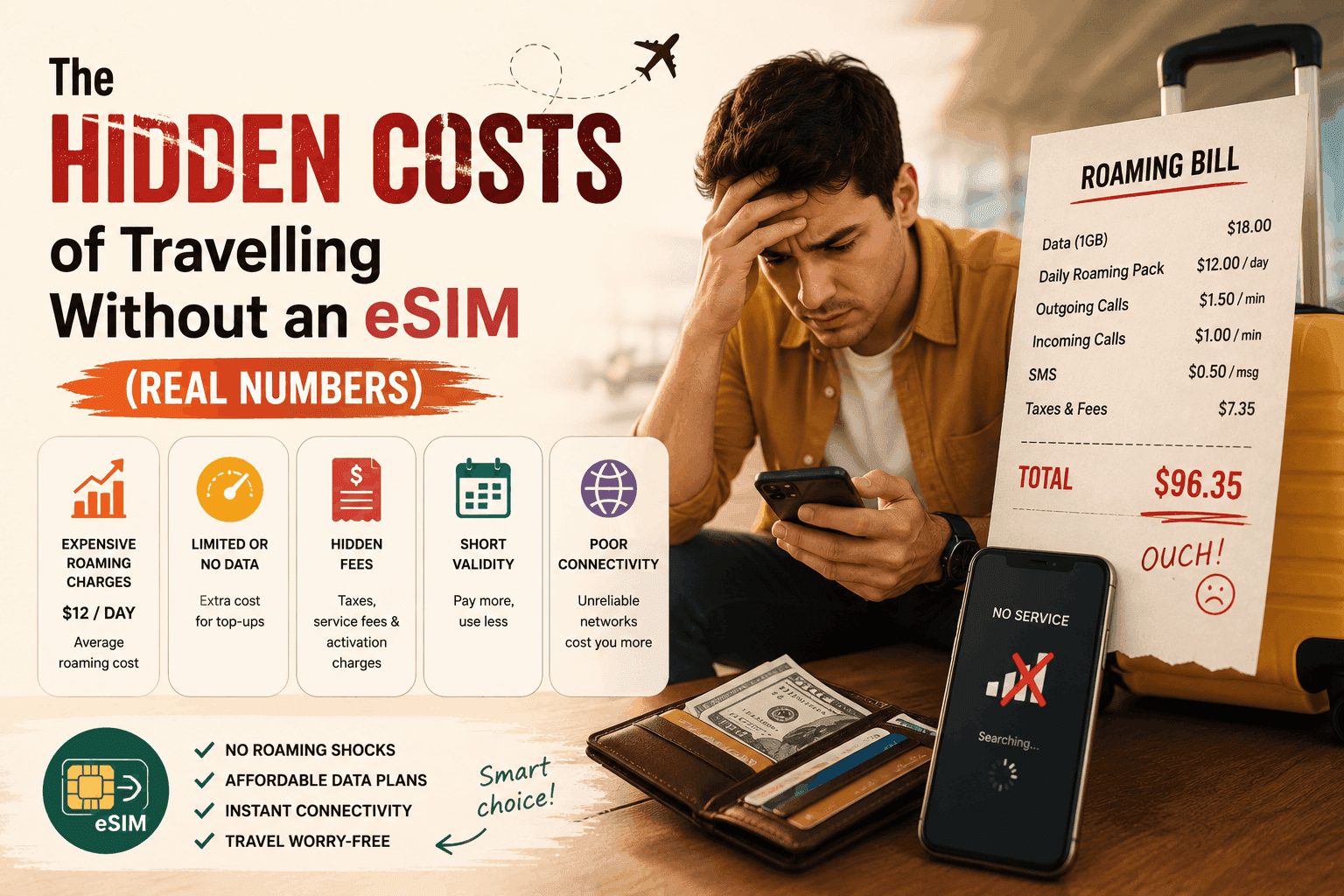
The Hidden Costs of Travelling Without an eSIM (Real Numbers)
Think roaming charges are just a small inconvenience? The hidden costs of travelling without an eSIM are bigger than most Canadian travelers realize — and the numbers prove it. Here’s exactly what you’re paying, broken down by trip type, traveler type, and carrier.
Most travel budgets account for flights, hotels, food, and activities. Almost nobody budgets for the phone bill — because it doesn’t feel like a choice. You land, you flip off airplane mode, and whatever your carrier charges, you pay.
That assumption is costing Canadian travelers hundreds of dollars per trip.
The hidden costs of travelling without an eSIM don’t show up until you’re already home. By then, the damage is done: a roaming bill that quietly doubled your daily spend, a family vacation that cost CA$800 more than it needed to, a two-week euro trip that came with a CA$252-per-person connectivity surcharge nobody mentioned at booking. These aren’t edge cases. They’re what happens when you travel with your Canadian carrier plan and don’t read the fine print before you fly.
This post puts real numbers to what travelling without an eSIM actually costs — by carrier, by destination, by trip length, and by household size — so you can make an informed decision before your next departure.
What Canadian Carriers Actually Charge for International Roaming in 2026
Let’s start with the published rates, because most travelers have a vague sense that roaming is “expensive” without knowing the specific numbers.
As of mid-2026, Canada’s Big Three carriers charge the following for international roaming:
- Rogers Roam Like Home: CA$16/day in 185+ countries
- Telus Easy Roam: CA$16/day in the US, CA$18/day everywhere else
- Bell Roam Better: CA$16/day, with a 5GB high-speed cap on Ultimate plans (after which speeds drop to 512Kbps for the rest of the day)
These are daily pass rates, and they activate automatically the moment you use your phone abroad — even if it’s just to check one email or receive a text. There’s no partial-day billing. Use your phone for five minutes or five hours on the same day: same charge.
That daily rate model sounds manageable until you do the math across a full trip.
The Real Numbers: What Roaming Actually Costs Per Trip
Solo traveler, 10-day US trip
Roaming on Rogers, Bell, or Telus: CA$130–160
A SimClaire US eSIM plan for the same trip: significantly less — and no surprise bill when you land at Pearson.
Solo traveler, 14-day Europe trip
A 14-day European trip on Telus Easy Roam, Rogers Roam Like Home, or Bell Roam Better runs roughly CA$224–252 per person. That’s before tax, before any overage charges, and before the daily cap kicks in and throttles your speed.
Family of four, 14-day Europe trip
For a family of four on a two-week trip in Europe at CA$16–18/day per device, the roaming total reaches nearly CA$900 in connectivity charges alone — on top of flights, hotels, and everything else.
CA$900 is two return flights between Toronto and London at off-peak prices. It’s four nights of mid-range accommodation in Rome. It’s a significant portion of the travel budget, quietly consumed by a phone bill.
Solo traveler, 21-day trip
A 21-day trip runs CA$336–378 in carrier roaming costs. A regional travel eSIM for the same duration and coverage costs a fraction of that.
What happens if you don’t have a roaming plan at all
International roaming without a plan can cost over CA$20 per megabyte on pay-per-use rates — meaning a single video call could run hundreds of dollars.Most carriers have moved away from pure pay-per-use billing, but the risk still exists for travelers who don’t activate a daily pass before their phone connects abroad.
The Costs Nobody Talks About
The daily rate is the obvious number. But the hidden costs of travelling without an eSIM go beyond the per-day charge. Here’s what else quietly adds up.
1. The automatic activation trap
Most carrier international plans activate automatically when you use your device abroad, even briefly. Check one email or receive a text message, and you’re charged for the entire day. There’s no partial-day billing — use your phone for five minutes or five hours, and the cost is identical.
For layovers, short border crossings, or an early morning arrival where you’re charged a full day rate for two hours of use before midnight — this trap catches thousands of Canadian travelers every year.
2. Throttling after daily caps
Bell’s 2026 restructured plans cap high-speed data at 5GB per day when roaming. After that, speeds drop to 512Kbps for the rest of the day. That’s roughly slow 3G — workable for a WhatsApp message, unworkable for Google Maps with live traffic, Spotify, or a video call.
You’re paying CA$16/day for a plan that stops performing like what you paid for the moment you hit 5GB. Telus and Rogers apply similar soft caps on roaming data even within their Easy Roam and Roam Like Home plans.
3. The CRTC complaint spike — because travelers are getting burned
The 2026 roaming landscape saw a 61% spike in customer complaints to the CCTS (Commissioner for Complaints for Telecommunications Services). That’s not a statistic about confused customers — it’s a signal that the gap between what carriers market and what travelers experience is widening.
The CRTC has now introduced a CA$50 usage alert mandate, designed to warn travelers before they cross thresholds. It’s a useful protection — but it doesn’t change the underlying rates, and the structural reality of three carriers controlling roughly 90% of the market, with daily roaming fees in the CA$16–18 range, is unlikely to change because of a regulatory tweak.
4. The productivity cost of throttled Wi-Fi hunting
This one never shows up on a bill, but it’s real. Travelers without reliable mobile data spend a disproportionate amount of trip time hunting for free Wi-Fi — in coffee shops, hotel lobbies, airport terminals — rather than navigating, booking, or just being present on the trip they paid for.
The hidden cost of travelling without an eSIM isn’t just financial. It’s the taxi you couldn’t book because Maps wasn’t loading. It’s the reservation you couldn’t confirm because the restaurant’s website timed out. It’s the 20 minutes of your Rome afternoon spent arguing with a café’s Wi-Fi password.
The eSIM Alternative: What the Same Connectivity Actually Costs
The same data on a travel eSIM for a 10-day US trip runs about CA$35 per person — compared to CA$130–160 on a carrier roaming plan.
Travel eSIM plans save Canadian travelers up to 84% compared to their carrier’s roaming rates.
For most travelers from Canada, a travel eSIM will cost 60–90% less than a carrier day pass for the same trip.
The math across different trip scenarios looks like this:
| Trip | Carrier Roaming (est.) | Travel eSIM (est.) | Estimated Saving |
|---|---|---|---|
| Solo, 10 days USA | CA$130–160 | CA$25–40 | CA$100–130 |
| Solo, 14 days Europe | CA$224–252 | CA$30–55 | CA$180–210 |
| Family of 4, 14 days Europe | CA$896–1,008 | CA$120–220 | CA$700–800 |
| Solo, 21 days multi-country | CA$336–378 | CA$45–75 | CA$280–310 |
These aren’t marketing estimates. They’re based on published Big Three rates versus real regional eSIM plan pricing — the kind of comparison you can verify before you book.
“But My Plan Includes International Roaming” — Does It Really?
This is the most common objection — and the most important one to unpack.
Many Canadian phone plans include some form of international data, often described as “unlimited” or “included roaming.” What that typically means in practice is one of three things:
Option A: A fixed number of roaming days are included (e.g., 10 days/year), after which standard daily rates apply.
Option B: “Unlimited” roaming data that throttles to 128Kbps or 256Kbps after a soft cap — speeds too slow for most modern travel use cases.
Option C: Roaming that’s included in premium plan tiers at CA$90–120/month, which only makes financial sense if you travel internationally more than once per billing cycle.
In none of these cases is the actual connectivity equivalent to what a local data line delivers. A travel eSIM connects directly to a local 4G or 5G network in your destination country. Carrier roaming adds extra routing between you and the local tower, which can slow your speeds — meaning even when you’re paying CA$16/day, you’re often not getting the same performance as a local subscriber on the same network.
Who Gets Hit Hardest by Roaming Costs
The hidden costs of travelling without an eSIM don’t affect every traveler equally. Some groups consistently end up paying the most.
Families traveling together bear the steepest cost simply because the daily charge multiplies by device. A family of four on Rogers Roam Like Home in Europe for 14 days is looking at close to CA$900 in connectivity before a single tourist attraction is visited.
Long-stay travelers — snowbirds, digital nomads, study-abroad students — face the scenario where a monthly eSIM plan at a flat rate is dramatically cheaper than 30 individual roaming days at CA$16 each (CA$480/month on Telus Easy Roam).
Frequent international travelers who haven’t reassessed their connectivity setup in the last two years are almost certainly overpaying. The eSIM math wins by 80–95% for leisure travelers, families splitting connectivity costs, and anyone going for more than a few days.
First-time international travelers are most vulnerable to the automatic activation trap — landing, turning off airplane mode out of habit, and racking up a full day’s roaming charge before they’ve even reached baggage claim.
What SimClaire Does Differently
SimClaire’s eSIM plans are built around the way Canadians actually travel — not around the daily rate model that makes roaming expensive.
Instead of paying CA$16 per day regardless of how much or how little you use your phone, you choose a fixed-data or unlimited plan sized to your actual trip. A 10-day Europe trip with moderate data use costs a fraction of what Rogers, Telus, or Bell charge for the same ten days. A 30-day multi-country trip costs the kind of flat rate that makes monthly budgeting straightforward.
The specifics:
- 150+ destinations covered — including the countries Canadian carriers quietly exclude from their standard roaming tiers
- QR code delivered by email — install before you fly, activate the moment you land
- Dual-SIM compatible — your Canadian number stays active for calls and texts while the SimClaire eSIM handles data
- No automatic activation traps — your eSIM data is yours to use on your schedule, not triggered by a background email sync at 3am
- WhatsApp support — real help when you need it, not a ticket queue that resolves after you’ve already landed home
The hidden costs of travelling without an eSIM are real, they’re significant, and they compound with every trip and every device on your plan. The fix is a five-minute setup before you fly.
Building your bridge to the world — without the roaming bill. 🧡
See what you’d actually pay for your next trip. Browse SimClaire’s eSIM plans at simclaire.com or reach us on WhatsApp at +1 437-605-6560.
Quick Reference: Canadian Carrier Roaming Rates 2026
| Carrier | USA Daily Rate | International Daily Rate |
|---|---|---|
| Rogers Roam Like Home | CA$16/day | CA$16/day (185+ countries) |
| Telus Easy Roam | CA$16/day | CA$18/day |
| Bell Roam Better | CA$16/day | CA$16/day (5GB cap, then throttled) |
Rates verified as of mid-2026. Always confirm current rates directly with your carrier before traveling.