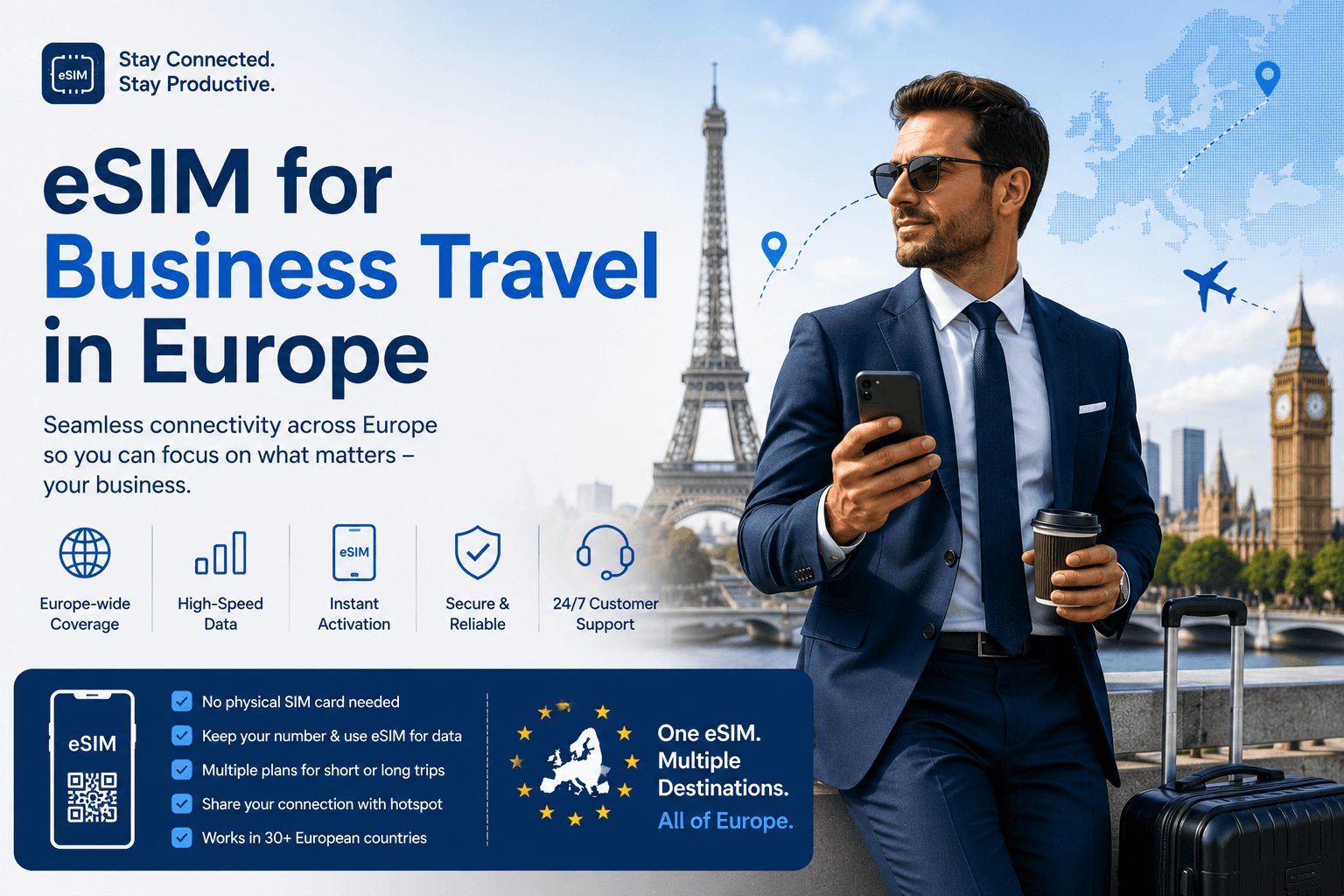
eSIM for Business Travel in Europe: What Actually Matters in 2026
Picking an eSIM for business travel in Europe is a different exercise from picking one for a holiday. A tourist who loses signal for an hour is mildly inconvenienced. A consultant who cannot dial into a client call from a taxi in Milan, or cannot receive the SMS code that unlocks their corporate VPN, has a real problem with real money attached to it.
Most travel eSIM plans are built for tourists. They sell data, they sell it cheaply, and they assume you will do everything through WhatsApp. That assumption breaks down fast on a business trip, where you still need to phone a hotel about a late check-in, call a client’s landline, reach a driver waiting at the wrong terminal, and receive one-time passcodes from systems that only send SMS.
This guide covers what separates a workable eSIM for business travel from a cheap tourist plan: voice and SMS, hotspot support, cross-border coverage, expense documentation, and how much data a working week actually consumes. SimClaire operates as a marketplace, so you can compare plans across providers and filter for the specifications that matter to a working traveller rather than taking whatever the first result offers.
Quick Answer: What Is the Best eSIM for Business Travel in Europe?
The best eSIM for business travel in Europe is a regional plan that includes voice minutes and SMS, covers every country on your itinerary, explicitly permits hotspot tethering, and has validity comfortably longer than your trip.
Data-only plans are cheaper, and they are the wrong choice for most trips. An eSIM for business travel has to do things a holiday plan never has to do. The saving is a few dollars. The cost of not being able to make a phone call during a working week abroad is considerably higher.
If your trip is a single city and a single country, a country-specific plan usually gives better value and stronger network performance. If you are crossing borders — which most European business itineraries do — a regional plan avoids buying a new eSIM in every market.
Who this guide is for
- Consultants, salespeople and account managers working across European markets
- Founders and executives on investor or client roadshows
- Engineers and technical staff on customer sites abroad
- Anyone attending trade shows, conferences or industry events in Europe
- Employees whose company will not approve a €15-per-day roaming add-on
Why “Roam Like at Home” Makes an eSIM for Business Travel Essential
There is a widespread assumption that roaming in Europe is solved, and that anyone shopping for an eSIM for business travel is overthinking it. It is solved — but only for people who live there.
The EU’s Roam Like at Home rules let residents of EU and EEA countries use their domestic minutes, texts and data across the bloc at no extra charge, and the European Parliament confirms these rules run until 2032. The scheme now also covers Ukraine and Moldova as of January 2026.
None of that applies to a traveller flying in from Canada, the United States, the UK or anywhere else outside the zone. Your home carrier’s European roaming is governed by your own contract, not by EU regulation — which is exactly why a travel eSIM for business trips tends to cost a fraction of what your carrier charges for the same week.
If you are unsure what your own plan does abroad, our breakdown of how roaming charges actually work walks through the per-day and per-megabyte models carriers use.
What to Look for in an eSIM for Business Travel
Voice Minutes and SMS, Not Just Data
This is the specification that separates a business-grade plan from a tourist one, and it is the one most people discover too late.
A data-only eSIM cannot dial a regular phone number. On a working trip that means you cannot:
- Call a client’s office line or a colleague’s desk phone
- Phone the hotel when your flight lands at midnight and reception has gone quiet
- Reach a driver, a venue coordinator or a courier
- Call a bank or card issuer after a transaction gets flagged abroad
- Receive SMS one-time passcodes from systems that do not support app-based authentication
WhatsApp and Teams calls cover some of this, but only when the other party is on the same platform. Hotels, taxi dispatchers, receptionists and banks generally are not. Filtering for combo plans that bundle minutes and SMS is the single highest-value decision when choosing an eSIM for business travel.
Hotspot Support for Your Laptop
Real work happens on a laptop, so any eSIM for business travel needs to reach one. If your plan does not permit tethering, your laptop is stuck on hotel or venue Wi-Fi — which is congested at conferences, unreliable in older hotels, and a poor idea for anything sensitive. Confirm that hotspot use is explicitly allowed, and check whether tethered data is capped below the headline allowance.
Regional Coverage Across Every Border
European business itineraries rarely stay in one country. A Monday in Amsterdam, Wednesday in Frankfurt, Friday in Zurich is an ordinary week — and Switzerland is not in the EU, so it drops out of plenty of “Europe” bundles. Check the country list against your actual calendar, including the UK if London is on it.
Validity That Outlasts the Trip
Business trips get extended. A meeting moves, a deal needs another day, a flight gets cancelled. Buy validity with margin rather than matching your itinerary exactly, because topping up mid-trip is more disruptive than paying slightly more upfront.
Documentation You Can Expense
You will need to expense this. An eSIM for business travel is a business purchase, and it should produce a business receipt. Check that you receive an itemised receipt or invoice at purchase with the vendor name and amount, and that it arrives at an email address you can access from the road. This sounds trivial until you are reconstructing a expense report six weeks later from a payment confirmation you deleted.
How Much Data Does an eSIM for Business Travel Need?
The data an eSIM for business travel needs skews differently from leisure usage: less streaming, far more video calls, email with attachments, cloud file sync, and laptop tethering.
| Activity | Typical Consumption | Notes |
|---|---|---|
| Video call (Teams, Zoom, Meet) | 1.5–3 GB per hour at HD | The dominant cost on most business trips |
| Voice-only call over data | 30–50 MB per hour | Negligible by comparison |
| Email with attachments | 50–150 MB per day | Higher if your client sends decks |
| Cloud sync (OneDrive, Drive, Dropbox) | 500 MB – 3 GB per day | Turn off automatic sync before you fly |
| Navigation and transit apps | 100–300 MB per day | Download offline maps to reduce this |
| Laptop tethering, general work | 1–2 GB per day | On top of phone usage |
Practical guidance by trip length:
- Two to three days, light usage: 5 GB is usually enough if you avoid tethering.
- A standard working week: 10–20 GB covers most travellers comfortably.
- A week with daily video calls and laptop tethering: 30 GB or an unlimited plan.
- Multi-week assignment: unlimited, or a high-cap plan with top-up available.
The biggest avoidable drain is background cloud sync. Pausing OneDrive, Google Drive, Dropbox and automatic photo backup before departure routinely halves consumption, and costs you nothing.
eSIM for Business Travel vs Your Carrier’s Roaming Add-On
| Travel eSIM | Carrier roaming pass | |
|---|---|---|
| Cost structure | Fixed prepaid amount, known before departure | Daily fee, charged for every day you use it |
| Multi-country trips | One regional plan covers the route | Usually fine, but priced per day regardless |
| Your work number | Stays active on your home SIM for calls and texts | Stays active |
| Local calling | Combo plans include minutes and SMS | Included, at your domestic rate |
| Expense clarity | One receipt, one line item | Buried in a bill that arrives weeks later |
| Setup | Install before you fly | Automatic |
Carrier roaming wins on convenience and on keeping your work number fully live. A prepaid travel eSIM wins decisively on cost and on expense clarity — one clean receipt rather than a surcharge you have to explain to finance a month later.
Most experienced travellers run both: home SIM active for their work number with data roaming switched off, travel eSIM handling all data and local calling. Dual SIM makes this straightforward, and our comparison of eSIMs and physical SIM cards covers the mechanics.
The One-Time Passcode Problem
This deserves its own section because it strands people more often than any other connectivity issue, and because no eSIM for business travel fixes it on its own.
Corporate systems, banks and payment platforms frequently fall back to SMS verification. If your work number is on a home SIM you have switched off to avoid roaming charges, those codes go nowhere. If your travel eSIM is data-only, it has no number capable of receiving them either.
Three things to do before you fly:
- Move corporate MFA to an authenticator app. Microsoft Authenticator, Okta Verify and Google Authenticator generate codes offline, with no network needed at all.
- Keep your home SIM enabled for calls and texts with data roaming explicitly disabled. Incoming SMS is typically free or trivially cheap; it is data that generates the bill.
- Choose a plan with SMS capability so you have a second working number if the first fails.
Sorting this out takes ten minutes at your desk and prevents the specific failure mode of being locked out of your own systems in a foreign city.
Choosing an eSIM for Business Travel by Trip Type
Single City, Single Country
A country-specific plan on a major local network gives the best performance and usually the best price. Two to five days of normal usage rarely needs more than 5–10 GB. Voice minutes still matter for hotel and client calls.
Multi-Country Week
A regional eSIM for business travel is the obvious choice — buying separate plans for three countries in five days wastes both money and time. Verify every country on your itinerary appears on the coverage list, and watch for non-EU stops like Switzerland, Norway or the UK.
Trade Shows and Conferences
Here an eSIM for business travel earns its cost outright. Venue Wi-Fi at large events is reliably terrible, and cellular networks around convention centres get congested during peak hours. Buy more data than you think you need, and treat your own connection as the primary one rather than the backup. If you are demoing anything live, tethering to a phone with a strong local signal beats venue Wi-Fi almost every time.
Extended Assignments
For anything over three weeks in a single country, compare an eSIM against a local postpaid or prepaid SIM, which can be cheaper at that duration. The trade-off is administration: local SIMs often require registration, an address, or an in-person visit. For most assignments under two months, an eSIM with a top-up option remains simpler.
Setting Up an eSIM for Business Travel Before You Fly
- Confirm your device supports eSIM. Almost all recent business phones do; Apple’s eSIM setup documentation lists supported models and the installation steps. See our activation walkthrough for a step-by-step version.
- Buy and install the profile at home, on stable Wi-Fi, ideally a few days out.
- Do not activate yet — validity generally starts at activation, not purchase.
- Disable data roaming on your home SIM while leaving calls and texts enabled.
- Set the travel line as your default for data and leave your work number as default for voice if you want it reachable.
- Pause cloud sync and automatic app updates.
- Download offline maps and any documents you will need on arrival.
- Save your receipt somewhere your expense system can reach.
- Activate on landing and confirm you have signal before leaving the terminal.
Border Queues and Why You Want Signal on Arrival
Since April 2026, the EU’s Entry/Exit System has been operating at Schengen external borders, replacing passport stamps with biometric registration. The rollout has produced longer queues at some airports and land crossings, and the European Commission maintains an official page on the EES and ETIAS timeline worth checking before you travel.
For anyone carrying an eSIM for business travel, the practical implication is simple: arrival can now take considerably longer than it used to, and you may need to message a client, reschedule a car, or tell a colleague you will miss the first half of a meeting — all while standing in a queue on the wrong side of border control. An active connection the moment you land is no longer a nicety.
ETIAS, the separate travel authorisation for visa-exempt visitors including Canadians, Americans and Britons, is targeted for late 2026 but has been repeatedly delayed and is not yet in force. Check the official EU page rather than any commercial site before your trip, since third-party ETIAS sites are a well-documented scam vector.
One thing that never depends on your plan: emergency numbers work from any phone with a signal, active plan or not. In Europe that is 112, as the EU’s own travel guidance confirms.
Common Mistakes When Buying an eSIM for Business Travel
Buying a data-only plan. The most frequent and most costly error when buying an eSIM for business travel. Calling capability is what turns a tourist plan into a working one.
Forgetting Switzerland or the UK. Both sit outside the EU and outside plenty of regional bundles, and both appear constantly on business itineraries.
Leaving cloud sync running. A single large file syncing over cellular can consume a day’s allowance before your first meeting.
Assuming hotel Wi-Fi is adequate. For a client call it frequently is not, and for anything sensitive it should not be your only option.
Not checking whether tethering is permitted. If your laptop needs the connection, verify this before purchase, not on arrival.
Cutting validity too fine. Trips extend. Build in margin.
Losing the receipt. Trivial to avoid, tedious to fix at expense time.
Where to Compare an eSIM for Business Travel
SimClaire is a marketplace rather than a single provider, which matters when your requirements are specific rather than generic. Comparing an eSIM for business travel across providers surfaces the combo plans that price comparison sites bury.
Filter for what business trips actually need. Voice minutes, SMS, hotspot permission, validity length and country coverage — not just price per gigabyte.
Combo plans that include calling. The specification most tourist-focused providers do not lead with, and the one that determines whether your trip works.
Compare across providers. Coverage and pricing vary by country and by duration. Comparing beats defaulting to whichever brand you have heard of.
Country, regional and global options for single-market trips and multi-city routes alike.
Buy and install before departure, with a receipt you can file.
Final Verdict: Choosing the Right eSIM for Business Travel
For most European trips, the right eSIM for business travel is: a regional plan including voice minutes and SMS, with confirmed hotspot support and validity longer than your itinerary.
For a single-city trip: a country-specific plan on a major local network, 5–10 GB, with calling included.
For a week of client meetings and video calls: 30 GB or unlimited, hotspot enabled.
For conferences and trade shows: more data than you estimate, treated as your primary connection rather than a backup.
For assignments over a month: compare against a local SIM, but weigh the registration friction.
The decision that matters most is not price. It is whether the plan can make a phone call. Everything else on a business trip has a workaround; that one does not.
Frequently Asked Questions
Install at home on stable Wi-Fi a few days before departure, then activate on landing. Validity typically starts at activation rather than purchase, so early installation costs nothing.
Yes. Dual SIM lets your home line stay active for incoming calls and texts to your work number while the travel line handles all data. Switch data roaming off on the home line to avoid charges.
For stays beyond roughly two months in one country, a local SIM can be cheaper. Below that, an eSIM is simpler — no registration paperwork, no in-person visit, and you can install it before you leave.
Yes, provided the plan explicitly permits hotspot use. Some plans allow tethering but apply a lower cap to tethered data, so confirm both before purchasing.
No. Roam Like at Home applies to residents of EU and EEA countries. Visitors from Canada, the US, the UK and elsewhere are governed by their own carrier’s international terms, which is why a local travel plan is typically far cheaper.
Usually, and often substantially, because carrier passes charge a daily fee for every day of the trip. A prepaid plan is also a single clean line item for expenses rather than a surcharge buried in a bill that arrives weeks later.
Roughly 5 GB for two or three light days, 10–20 GB for a standard working week, and 30 GB or unlimited if you have daily video calls or tether a laptop. Video conferencing is the dominant consumer at 1.5–3 GB per hour.
Only if the number those codes are sent to is reachable. Keep your home SIM enabled for calls and texts with data roaming switched off, and move corporate multi-factor authentication to an authenticator app before you travel — those generate codes with no network connection at all.
Only if the plan includes voice minutes. Most travel eSIMs are data-only, which means calls work through WhatsApp, Teams or FaceTime but cannot reach a regular phone number. Look specifically for combo plans that bundle minutes and SMS.
The best option is a regional plan that includes voice minutes and SMS, covers every country on your itinerary, permits hotspot tethering, and has validity longer than your trip. Data-only plans are cheaper but leave you unable to phone hotels, clients or drivers.