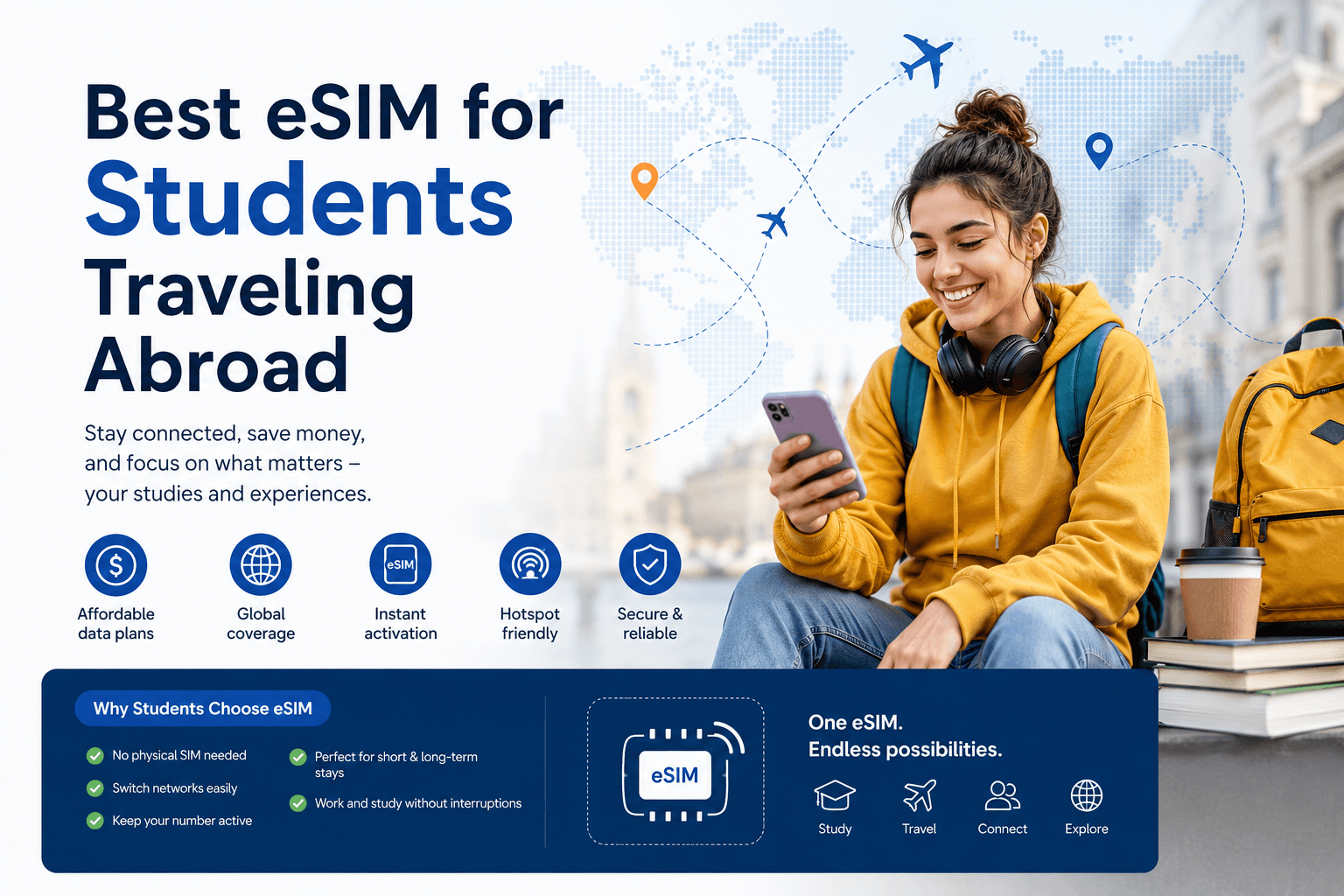
Best eSIM for Students Traveling Abroad (2026 Guide)
The best eSIM for students traveling abroad depends on where you’re studying, how much data you need, and whether you plan to visit multiple countries. Whether you’re spending a semester in Europe, studying in the USA, joining an exchange program in Japan, or backpacking through Southeast Asia after exams, having reliable mobile data makes it easier to navigate, attend online classes, communicate with family, and manage everyday life abroad.
That’s why more students are switching to travel eSIMs instead of paying expensive international roaming charges or searching for local SIM cards at the airport.
But not every eSIM is built with students in mind.
Some plans are inexpensive but offer very little data. Others include generous allowances but only work in a single country, making them unsuitable if you’re traveling across Europe or visiting neighboring countries during weekends or semester breaks.
This guide compares the best eSIMs for students traveling abroad, explains what features actually matter, and helps you choose the right plan based on your destination, budget, and length of stay.
If you’re looking for an affordable option that works across multiple countries with transparent pricing and quick activation, SimClaire is one of the providers worth considering.
Why Students Need an eSIM Instead of International Roaming
Studying abroad is already expensive. Accommodation, tuition, transport, insurance, and everyday expenses quickly add up. Paying high roaming charges simply to use Google Maps or message your family shouldn’t be another surprise expense.
A travel eSIM solves several common problems students face.
Stay connected from the moment you land
Rather than searching for a mobile store after a long flight, you can install your eSIM before departure and activate it as soon as you arrive. Your phone connects automatically to a supported local network, letting you book transport, contact your host, or navigate to your accommodation immediately.
Avoid expensive roaming charges
International roaming offered by home carriers is often one of the most expensive ways to stay connected abroad. Travel eSIMs provide prepaid data plans, allowing you to know exactly how much you’ll spend before your trip begins.
Perfect for weekend trips
Many students don’t stay in one country.
A semester in France often includes weekend trips to Italy, Spain, Germany, Belgium, or the Netherlands.
Choosing a regional or multi-country eSIM means you don’t need to purchase a new SIM every time you cross a border.
Quick installation
Most travel eSIMs can be installed in just a few minutes using a QR code sent by email.
There are no physical SIM cards to collect, swap, or risk losing during your trip.
What Students Should Look for Before Buying an eSIM
Not every traveler has the same connectivity needs.
Someone attending a one-week summer program doesn’t need the same data plan as a student spending an entire academic year overseas.
Before purchasing an eSIM, consider these factors.
1. Coverage
The first question isn’t “How much data?”
It’s “Where will I be traveling?”
Choose an eSIM that supports every country on your itinerary.
For example:
- Studying in Germany while visiting France and Italy
- Exchange semester in Japan with trips to South Korea
- University program in the USA followed by travel through Canada
- Southeast Asia backpacking after graduation
Buying one regional eSIM is often simpler than purchasing separate country plans.
2. Data Allowance
Students rely heavily on mobile data throughout the day.
Common activities include:
- Google Maps
- Microsoft Teams
- Zoom
- Google Meet
- Spotify
- TikTok
- YouTube
- Cloud storage
- Food delivery apps
- Ride-hailing apps
Choosing the cheapest plan isn’t always the best decision if it means constantly worrying about running out of data.
3. Validity Period
Match your plan with your stay.
| Trip Duration | Recommended Plan |
|---|---|
| 1 week | 5–10 GB |
| 2 weeks | 10–20 GB |
| 1 month | 20–30 GB |
| Semester (3–6 months) | Monthly renewable plan |
| Full academic year | Long-term or renewable regional plans |
4. Multi-country Support
If you’re studying in Europe, don’t only compare “France eSIM” plans.
Instead, check whether the provider offers a Europe-wide plan covering dozens of countries under one eSIM.
This saves both money and time during holidays and weekend trips.
5. Hotspot Support
Many students carry laptops and tablets.
Being able to share your phone’s internet connection is valuable when:
- University Wi-Fi is unavailable
- You’re studying in a café
- You’re on a train
- You’re attending online lectures
- You’re working remotely
Always confirm that hotspot and tethering are supported before purchasing.
6. Easy Activation
The best providers let you:
- Purchase online
- Receive the QR code instantly
- Install before departure
- Activate automatically upon arrival
The fewer setup steps, the better.
How Much Data Does a Student Actually Need?
One of the biggest questions students ask is:
“How many GB do I really need?”
The answer depends on how you use your phone.
Here’s a rough estimate for one month.
| Activity | Approximate Data Usage |
|---|---|
| WhatsApp messages | Very Low |
| Google Maps | 3 to 5 GB |
| Music streaming | 4 to 8 GB |
| Instagram & TikTok | 15 to 40 GB |
| YouTube (1080p) | 20 to 60 GB |
| Zoom / Google Meet | 20 to 70 GB |
| Cloud backups | High |
Recommendations
Light users
Mostly messaging, maps, emails, and occasional browsing.
Recommended:
- 10 GB per month
Average students
Daily social media, navigation, university portals, music streaming, and occasional video calls.
Recommended:
- 20–30 GB per month
Heavy users
Online classes, HD streaming, hotspot use, cloud storage, and frequent video calls.
Recommended:
- 40 GB or more per month
Looking for the Right Student eSIM?
The best eSIM isn’t always the cheapest one. Students should balance coverage, data allowance, validity, and ease of use to avoid unexpected costs while abroad.
In the next section, we’ll compare SimClaire with popular travel eSIM providers like Airalo, Holafly, Nomad, and Saily, looking at pricing, coverage, flexibility, and which option offers the best value for students studying overseas.
Why SimClaire is a Smart Choice for Students Studying Abroad
Choosing the right eSIM isn’t just about finding the cheapest plan. As a student, you need a provider that keeps you connected throughout your journey, whether you’re attending lectures, navigating a new city, joining video calls with family, or exploring neighboring countries during semester breaks.
SimClaire is designed for travelers who want reliable connectivity without the hassle of buying local SIM cards every time they cross a border.
Multi-country Coverage
Many students travel beyond their study destination.
You might spend a semester in Germany and visit France, Italy, Austria, and the Netherlands during weekends. Or perhaps you’re studying in Canada while planning a road trip across the USA.
With SimClaire, you can choose regional and multi-country eSIM plans that help you stay connected without purchasing a new SIM card for every country.
Affordable Plans for Every Budget
Student budgets are limited.
Instead of paying expensive roaming charges or airport SIM card prices, SimClaire offers prepaid travel eSIM plans that let you know exactly how much you’ll spend before your trip begins.
Whether you need:
- A small data package for occasional browsing
- A monthly plan for everyday university life
- A higher-data option for streaming and online classes
there’s a plan suited to different travel styles and budgets.
Instant Digital Delivery
There’s no need to wait for a physical SIM card.
After completing your purchase, your eSIM is delivered digitally by email along with simple installation instructions and a QR code.
You can install it before leaving home and activate it when you arrive at your destination.
Easy Installation
Getting started only takes a few minutes.
Step 1
Choose your destination and select the plan that best matches your trip.
Step 2
Complete your purchase and receive your QR code instantly.
Step 3
Install the eSIM while connected to Wi-Fi, then activate it when you arrive.
No waiting in airport queues.
No physical SIM cards.
No complicated setup.
Which SimClaire Plan is Best for Students?
The ideal plan depends on how you use your phone.
| Student Type | Recommended Plan |
|---|---|
| Light User | 5–10 GB |
| Everyday Student | 20–30 GB |
| Heavy Social Media User | 30–50 GB |
| Online Classes & Hotspot | 40 GB+ |
| Multi-country Travel | Regional eSIM |
If you’re unsure, choosing a plan with a little more data is often better than running out during an important lecture or while navigating an unfamiliar city.
Frequently Asked Questions
Is an eSIM better than buying a local SIM card?
For many students, yes.
A travel eSIM can be installed before departure, activates quickly upon arrival, and eliminates the need to visit local mobile stores or swap physical SIM cards.
Can I keep my WhatsApp number?
Yes.
WhatsApp remains linked to your existing phone number. Installing an eSIM for mobile data won’t change your WhatsApp account.
Can I receive OTPs and verification codes?
Yes.
If your primary SIM remains active, you can continue receiving SMS verification codes and banking OTPs while using your travel eSIM for internet access.
Can I use my phone as a hotspot?
Many SimClaire plans support hotspot and tethering, allowing you to share your connection with a laptop or tablet. Check the plan details before purchasing to confirm support.
Should I install my eSIM before flying?
Yes.
Installing your eSIM while you have a stable Wi-Fi connection at home makes activation much easier. Once you land, simply enable the eSIM and connect to a supported network.
Do I need a different eSIM for every country?
Not necessarily.
If you’re visiting multiple destinations, a regional or multi-country eSIM may cover your entire trip, making it more convenient than purchasing separate country plans.
Final Thoughts
Studying abroad is one of the most exciting experiences you’ll have. Staying connected shouldn’t be another thing to worry about.
Whether you’re finding your way around campus, attending online classes, booking weekend trips, or keeping in touch with family back home, a reliable travel eSIM makes life significantly easier.
The best eSIM for students depends on your destination, trip duration, and expected data usage. Compare coverage, pricing, and flexibility before making a decision.
If you’re looking for an affordable travel eSIM with straightforward prepaid plans, multi-country coverage, and quick digital activation, SimClaire is worth considering for your next study abroad adventure.
Ready to Stay Connected?
Explore SimClaire’s travel eSIM plans and choose the one that matches your destination and study schedule.
- Browse destination eSIMs
- Check device compatibility
- Learn how to install your eSIM
- Compare regional and global plans
Start your journey connected, so you can focus on learning, exploring, and making the most of your time abroad.
The best eSIM depends on your destination, trip length, and data usage. Students should look for wide coverage, affordable pricing, easy activation, and flexible data plans. If you’re traveling to multiple countries, choose a regional or global eSIM instead of buying separate plans for each destination.
In most cases, yes. Travel eSIMs offer prepaid data plans with transparent pricing, helping students avoid expensive roaming charges from their home mobile carrier. You pay only for the data you need before your trip begins.
Yes. Most modern smartphones support Dual SIM functionality, allowing you to keep your physical SIM active for calls and SMS while using an eSIM for mobile data. This lets you continue receiving banking OTPs and verification messages.
Yes, if you purchase a regional or global eSIM. These plans cover multiple countries under one eSIM, making them ideal for students traveling during semester breaks or exchange programs.
Light users generally need around 10 GB per month. Students who frequently use maps, social media, music streaming, and video calls should consider 20 to 30 GB. Heavy users attending online classes or using hotspots may require 40 GB or more.
Yes. WhatsApp remains linked to your phone number, not your SIM card. Installing a travel eSIM for mobile data will not affect your WhatsApp account or chats.
Yes. Installing your eSIM before departure while connected to a reliable Wi-Fi network makes activation easier. Once you arrive, simply enable the eSIM and connect to a supported local network.
Most recent iPhone, Samsung Galaxy, Google Pixel, and many flagship Android devices support eSIM technology. You can also check your phone’s settings or use SimClaire’s device compatibility page before purchasing.
How to Buy and Activate a Student eSIM
- Choose your destination and estimate how much mobile data you’ll need during your trip.
- Select a travel eSIM plan that matches your destination and trip duration.
- Complete your purchase online and receive your eSIM QR code by email.
- Install the eSIM while connected to Wi-Fi before you travel.
- After arriving at your destination, enable the eSIM and mobile data to connect to a supported local network.
- Enjoy reliable internet for navigation, communication, online classes, and everyday travel.